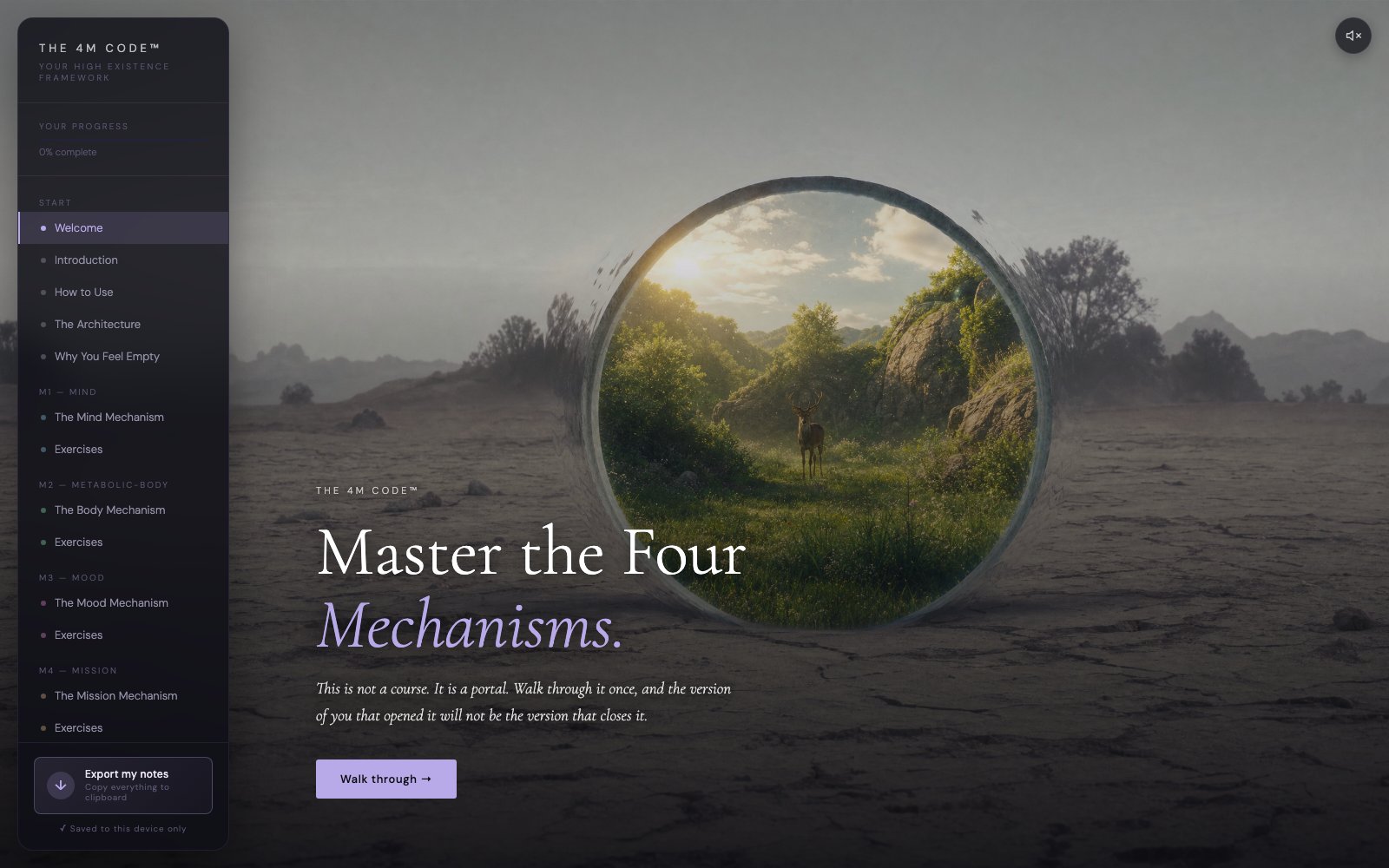
This is not a course. It is a portal. Walk through it once, and the version of you that opened it will not be the version that closes it.
Introduction
Before you begin.
A few honest words before you cross the threshold.
◆ Before we go further
You're already ahead of 97% of people.
I don't say that lightly, and I don't say it to flatter you.
The vast majority of people sense, somewhere deep, that they're not living the life they could be living. They feel it. They know it. And then they push the thought down, scroll past it, drown it in another distraction, and tell themselves they'll figure it out "someday."
Someday rarely comes.
You're different. Not because you've solved anything yet, but because you stopped pretending. You bought this workbook. You opened it. You're sitting with a part of yourself that wants more, and instead of running from it, you're walking toward it.
That is rarer than you think. And it's the only step that actually matters at the start.
And while we're being honest with each other: you get to do this. This life. This choice. The very fact that you have the time, the safety, and the space to even ask "is there more?" puts you ahead of more than 99% of the world. Most people are surviving. You're choosing.
So before we begin: recognise this for what it is. A first step. A real one. Take it in.
Most people who end up here don't come because everything is going great. They come because something feels off. It might be a whisper, a restlessness, a sense that the life they're living isn't the one they were meant for.
Or it might be something louder. A breakup. A burnout. A job loss. A moment where the world pulls the emergency brake for you.
I've lived through both. And if I'm being honest, I ignored the first kind for years. I always had this feeling that there was more to life, not in a dramatic way, just a steady sense that I wasn't aligned. My thinking, saying and doing were not equal. I was out of tune with myself.
And then I heard something that changed everything.
The thought that ignited me
"What if I told you that you're only six months away? Six months away from the life you've always dreamt of, the health you've always dreamt of, the income, the lifestyle, or the body of work you've always dreamt of?
What if I told you that your success was guaranteed and that the person you've always dreamt of becoming was only six months away?
There's just one condition though. For that time, you have to show up each and every day and do all the things you and I both know you should be doing.
How would you show up each day? If success were guaranteed and it was only six months away, what would you do differently?"
Tom Noske
When I heard these words, lightning struck me. They were the spark behind the leap I took in 2025, and the reason this workbook exists today.
In 2020, Corona forced a reset. An ending of a bad relationship. The first crack in the shell. I found true love shortly after. In 2021, I lost 30 kilos of fat. But physical transformation doesn't automatically bring mental clarity.
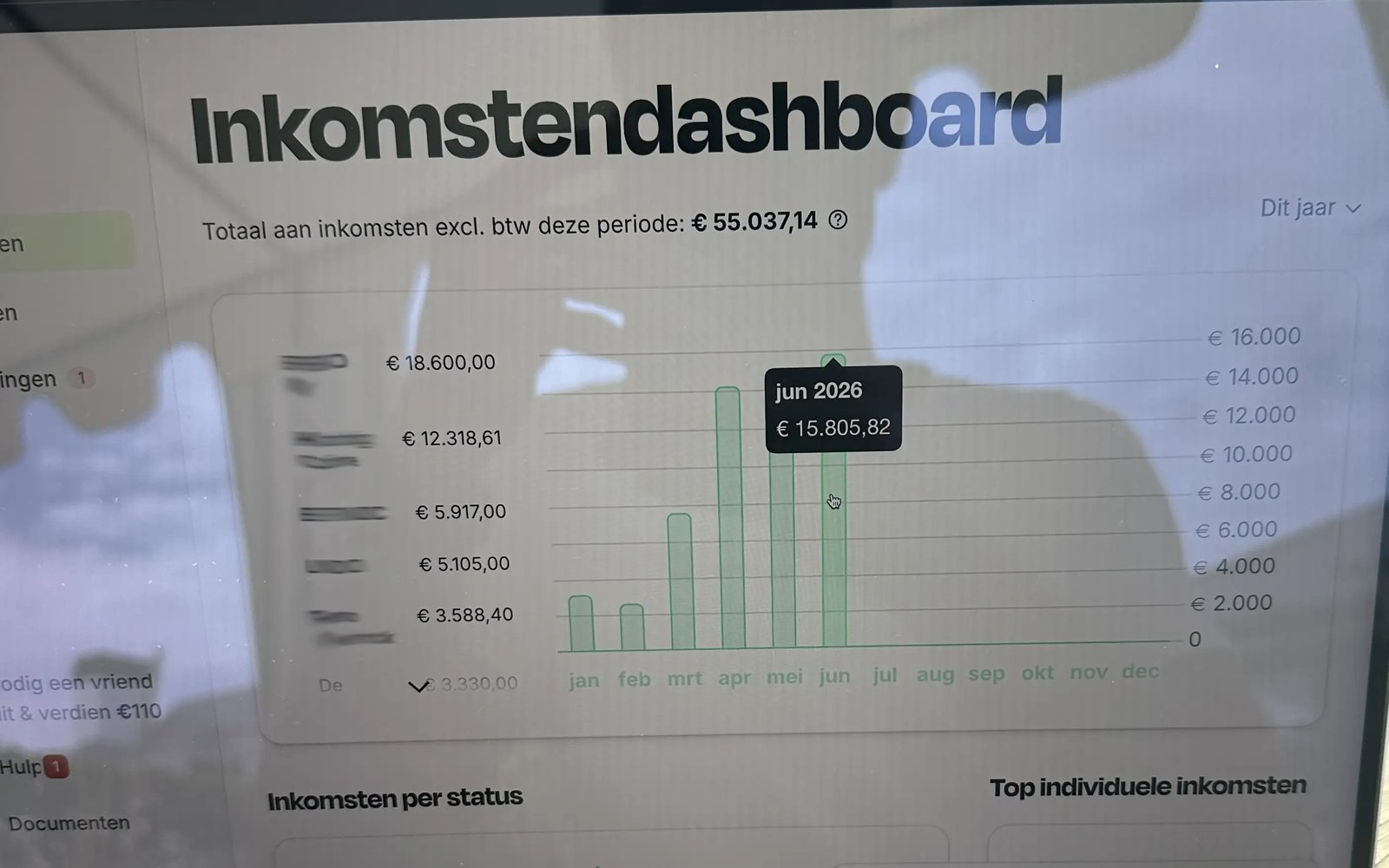
My real shift came in 2025. That's when I quit my job. Took the leap of faith. Stopped pleasing other people. And finally, completely stepped into my own alignment. Since April 2026, I've been consistently running €10k+ per month across my projects, not because I got lucky, but because I built the right systems.
The 4MC was born from that clarity. I built it because I genuinely believe it shouldn't take people as long as it took me. Ten years of friction can be reduced to one year of intentional living.
The life you want is not built on luck or talent. It's built on alignment. And alignment is built on structure.
That structure is The 4M Code.
How to use this workbook
A short guide before you begin the ascent.
This is not a book you read once. It is a workbook you live with. Some sections you will fly through in one sitting. Others you will revisit five times before something clicks. Both are right.
1
What this is, and what it isn't
What it is: a structured framework based on four mechanisms, Mind, Metabolic-Body, Mood, and Mission, that together form the operating system of a fulfilled life.
What it isn't: a quick fix, a 30-day challenge, or a copy of someone else's path. The exercises are personal. The answers are yours alone. I'm here as a guide, not a guru.
2
How to move through it
If you're new to this work: go in order. Mind, Body, Mood, Mission, then Your Final Passage. Each mechanism builds on the previous one. Don't rush. The exercises are the point, not the reading.
If you've done this kind of work before: jump to whichever mechanism is calling you loudest. You'll know which one when you scan the four. Trust that pull.
Pace: at minimum one mechanism per week. At maximum, take a year. There is no race.
3
What's inside each mechanism
Every mechanism follows the same shape, so once you've worked through one, you know the rhythm:
Core insights the principles to hold in your head. The Cost what it's silently taking from you right now. The Science evidence-based research that backs the work. From the Trenches a personal note from me. Self-Assessment a quick honest score so you know where to focus. Daily Checklist small wins that compound. Exercises deep journaling work where the real shift happens.
4
Your notes, your privacy
Every word you write in this workbook is saved only on your own device, in your browser's local storage. Nothing is uploaded. Nothing is sent anywhere. I cannot read what you write, and that's the point.
This means: be brutally honest. The exercises only work if you're more honest with this workbook than you are with anyone else, including yourself.
It also means: if you clear your browser data or use a different device, your notes won't follow you. So if something deeply important comes up, copy it somewhere permanent.
You can reset everything at any time using the link at the bottom of the sidebar. Fresh start, no questions asked.
5
The one rule
Don't just read. Do.
The people who've gone through this and built real momentum all share one thing: they didn't wait until they "understood it all" before they started. They picked one tiny action from the very first exercise and did it that same day.
You'll know the framework better after one week of action than after a month of reading. Always.
Your starting point, what brought you here?
✓ Saved
Framework
The Human Vehicle Metaphor
Think of yourself as a high-performance machine. Not in a cheesy way, in a structural, functional way.
Every part of this vehicle influences the other. When you understand the whole picture at once, everything that follows clicks into place. You'll see why your mind, body, emotional world and mission interact the way they do.
⤢ Click to enlarge
M1 — Mind
The Steering Wheel
Facilitates your next move. Your thoughts determine focus, direction, and whether you stay present or crash into autopilot.
M2 — Metabolic-Body
The Vehicle & Fuel
The physical structure that carries you through life. Clean fuel transforms performance. Low-quality fuel turns a Ferrari into a lawnmower.
M3 — Mood
The Wheel System
Traction and shock absorption. How you stay grounded, handle impact, navigate emotional terrain. Without this, everything wobbles.
M4 — Mission
The Direction
The map, the destination, the reason you drive at all. Without direction, the most powerful vehicle simply goes in circles.
When the mind steers with awareness, the body supports with strength, the metabolism fuels with purity, the heart grounds with stability, and the mission pulls you forward, you become unstoppable.
This is the integrated human. The architecture of a life lived on purpose. Each mechanism feeds the others. Neglect one and the whole system underperforms. Master all four, and life stops happening to you, it starts happening with you.
M1 — The Mind Mechanism
The Operating System of Your Life
Your mindset is the foundation of everything you create. It determines how you interpret experience, handle adversity, and ultimately, who you become.
A strong mindset doesn't mean thinking positive all the time. It means thinking clearly, acting intentionally, and choosing your reality instead of being shaped by it.
When your mind is weak, everything becomes heavier, decisions, habits, relationships, energy, emotions. When it's strong, you are grounded, flexible, and able to take action even when you don't feel like it.
"Your life is always moving in the direction of your strongest thoughts."
— Craig Groeschel
The Core Chain
Your thoughts create your standards → your standards create your habits → your habits create your identity → and your identity creates your life.
So if you want a new life, you don't need motivation. You need a new mindset.
Insight 01
Discipline over motivation
You don't act because you're motivated. You become motivated because you act.
Insight 02
Identity over outcomes
Don't do temporary things. Become the type of person who prioritizes health, fitness, and goals. Identity shifts last. Discipline based on willpower alone collapses.
Insight 03
Self-trust is everything
When you say "I will do X" and you do it, confidence rises. Confidence is not a feeling. It is a promise-keeping habit.
Insight 04
Focus expands reality
What you focus on expands, always. The state you operate from determines the quality of every action you take.
Insight 05
Obstacles are opportunities
The moment you understand an obstacle as a chance to grow, every difficulty becomes fuel. You stop fearing problems and start trusting yourself to solve them. This is the biggest flex in life, and it's a muscle you train.
⚠ The Cost
What a weak mind silently steals from you
Most people don't realize how much they're losing every day from an undisciplined mind. The damage isn't dramatic, it's slow, quiet, and compounds over years. Here's what it actually costs you:
Years of progress. Every "I'll start Monday" is another week stolen from your future self. Compound that over 10 years and you've lost a decade.
The version of you that almost was. Every limiting belief you don't challenge becomes a wall. Eventually you forget there was ever an outside.
Your self-respect. Every promise you break to yourself drops your internal credibility. After a while, you stop believing your own words. So does everyone around you.
Mental bandwidth. Unprocessed thoughts and unfinished decisions consume working memory. You walk around with 50 tabs open in your head and wonder why you feel exhausted.
Opportunities you can't even see. A scattered mind misses the doors that open. Focus is the difference between catching the wave and watching it pass.
The Science Behind The Mind
◉ Neuroscience
Your brain rewires itself based on what you repeat
Neuroplasticity research shows that every thought you think strengthens specific neural pathways. The thoughts you repeat become highways. Your "personality" is mostly automated thinking patterns.
— Dr. Andrew Huberman, Stanford Neuroscience
◉ Psychology
Identity drives behavior, not the other way around
Studies on habit formation show that lasting change happens when you shift identity first. "I am someone who exercises" beats "I should exercise" every single time.
— James Clear, Atomic Habits
◉ Behavioral
Discipline gets easier the more you use it
Self-control is like a muscle, but with a twist: people who practice it daily report it feeling effortless within 60-90 days. The first month is the only hard part.
— Dr. Roy Baumeister, willpower research
◉ Cognitive
Your inner voice shapes 80% of your reality
Research on metacognition shows that the average person has 60,000–80,000 thoughts per day. Most are negative, repetitive, and not even true. You don't have to believe everything you think.
— National Science Foundation
◐ From the trenches
"For years I told myself I couldn't quit my job because of the kids, the mortgage, the responsibility. It felt like a fact. It wasn't. It was a story I was telling myself to avoid the discomfort of changing. The day I caught that thought as a story instead of truth, was the day my life started moving."
Quinten, Founder, The 4M Code
The Learning Curve
Where most people give up.
Anything worth doing follows the same pattern, a curve known as the Dunning-Kruger effect. You start with naive confidence, crash into reality, and only those who push through reach mastery. If you understand this map before you walk it, you stop quitting at the exact moment growth begins.
Phase 1
Uninformed Optimism
"This is going to be easy." You're confident because you don't yet know what you don't know. Energy is high. Reality hasn't hit.
Phase 2 — The Crash
Valley of Despair
"This is harder than I thought. Maybe I'm not made for this." You quit here because you have no pain tolerance, you don't trust yourself, you keep doing the same thing without learning, or it stopped feeling fun. This is where 90% of people give up.
Phase 3
Informed Optimism
"I see how this works now." You've earned real knowledge through difficulty. Confidence returns, but it's grounded this time. Progress accelerates.
Phase 4
Mastery
"This is who I am now." The skill becomes part of your identity. You don't have to think about it anymore. You're now at the level others see and want to copy.
Where do you usually give up?
✓ Saved
◇ Self-Assessment
Where is your mind right now?
Rate yourself honestly on each. No one is watching. Your average score will tell you where to start.
I keep the promises I make to myself, even small ones.
When my mind goes negative, I notice it and redirect.
I take action even when I don't feel like it.
My mental focus is sharp throughout the day.
I am aware of the stories I tell myself about who I am.
,
Your Mind Score
Rate all 5 questions to see your score and personalized feedback.
Daily Mind Checklist
✓
I did one thing today that required discipline
✓
I replaced one limiting thought with a useful one
✓
I kept at least one small promise to myself
✓
I learned something new
✓
I took one action my future self will thank me for
M1 — Mind Exercises
Rewire Your Mind
These exercises build the mental habits that separate those who drift from those who drive.
Exercise 01
The 3 Thought Audit
Write three thoughts that are draining your energy right now. For each: identify if it's a fact or a story you're telling yourself. Then rewrite it to a powerful, action-oriented version.
Draining thought 1: Is it a fact or a story?
Draining thought 2: Is it a fact or a story?
Draining thought 3: Is it a fact or a story?
What belief do I need to let go of to become the next version of myself?
✓ Saved
Exercise 02
The Identity Installation
Answer these three questions to install a new identity, not through affirmations, but through behavior.
Who do I want to become?
What does this version of me believe?
What is one small action I can take today that aligns with this identity?
✓ Saved
Exercise 03
Reframing in Real Time
Pick one challenge you're currently facing and run it through the reframe process.
What meaning am I giving this situation?
What else could it mean?
How would the strongest version of me interpret this?
What is the opportunity hidden inside the difficulty?
✓ Saved
Exercise 04, 7-Day Micro Habit
Building Discipline Through Micro-Wins
Choose one micro habit you will do for the next 7 days. The goal is not the habit, it is to train your brain: "I do what I said I would do."
2 min journalingCold shower finishMake your bed5 push-upsRead 1 page
✓ Saved
M2 — The Metabolic-Body Mechanism
Your Body Is Not Broken. It Is Mismatched.
Energy is the foundational driver of everything. If you are well off physically, you will be stronger mentally and emotionally.
Almost all modern lifestyle issues, fatigue, low energy, bloating, poor sleep, low libido, stubborn weight, brain fog, stem from one core problem: a disrupted immune system and metabolism.
Our comfortable, industrialised lives represent less than 1% of our evolutionary history. For thousands of years, our bodies adapted to harsh, real challenges. Today the opposite is true. Constant food, sedentary jobs, endless comfort have confused our biology.
"You are not sick. Your environment and lifestyle are sick."
— KPNI principle
Intermittent Living
The solution is strategically reintroducing short, controlled "ancient" stressors that activate your body's survival pathways. Your body evolved to thrive in conditions of scarcity, temperature extremes, physical challenge, and fasting.
Practice 01
Intermittent Fasting (16–20h)
Autophagy, inflammation reduction, insulin sensitivity, mental clarity, metabolic flexibility. Start with 12h, build to 16–8.
Practice 02
Cold Exposure
1–3 min cold shower or ice bath. Dopamine up to 250%, immune boost, brown fat activation, inflammation reduction.
Practice 03
Fasted Morning Training
Low insulin + high adrenaline + fat-burning mode + BDNF release. Walking, HIIT, strength, zone 2 running.
Practice 04
Circadian Rhythm Alignment
Morning daylight before screens. No food 3h before bed. Regular sleep schedule. Dim light in the evening.
⚠ The Cost
What a neglected body silently steals from you
Modern life numbs the signals. You think you're "tired but fine." You're not. Here's what an underfueled, undertrained body is quietly costing you every single day:
Mental sharpness. Brain fog isn't a personality trait. It's a fueling problem. Most "I can't focus" issues are actually metabolic problems disguised as mental ones.
Decades off your lifespan. Chronic inflammation, insulin resistance, and bad sleep don't kill you fast. They steal years one slow afternoon at a time.
The energy to be a great parent, partner, or founder. You can't pour from an empty cup. Your kids, your work, your relationships all get the leftovers when your body is depleted.
Confidence. A body you don't trust shows up in everything, how you walk, how you dress, what risks you take. You can't fake your way out of how your own body feels.
Joy in your own skin. Most people forget what it feels like to wake up genuinely energized. You don't have to live that way.
The Science Behind The Body
◉ KPNI
Most modern diseases are mismatches, not defects
Clinical PsychoNeuroImmunology shows that fatigue, brain fog, autoimmune issues, and metabolic disease are often caused by a mismatch between modern lifestyle and ancient biology, not by genetics.
— Dr. Leo Pruimboom, founder of clinical KPNI
◉ Cold exposure
3 minutes of cold raises dopamine by 250%
Cold immersion produces a sustained dopamine release lasting hours, without the crash. It also activates brown fat, reduces inflammation, and trains your stress response.
— Dr. Andrew Huberman, Stanford
◉ Fasting
16-hour fasts trigger cellular repair (autophagy)
Autophagy is your body's recycling system. After 14–16 hours without food, damaged cells get cleaned out and replaced. It's also a key driver of fat loss and longevity.
— Dr. Yoshinori Ohsumi, Nobel Prize 2016
◉ Movement
Sitting more than 6 hours a day reduces life expectancy
Sedentary behavior is independently linked to mortality, even in people who exercise. Brief, frequent movement throughout the day is more protective than one daily workout.
— American Journal of Epidemiology
◐ From the trenches
"I lost 30 kilos in 2021. But the truth nobody tells you: that wasn't the hard part. The hard part was rebuilding my entire identity around being someone who actually takes care of his body. Old me ate his feelings. New me eats to fuel a life I actually want to live. The body change is just the visible result."
Quinten, Founder, The 4M Code
◇ Self-Assessment
How alive does your body feel?
Rate yourself honestly on each. Your average score reveals where the biggest leverage is.
I wake up feeling rested and energized most mornings.
My energy is stable throughout the day, without major crashes.
I move my body with intensity at least 3 times per week.
I eat real, unprocessed food most of the time.
I expose myself to natural stressors (cold, heat, fasting, hard effort) regularly.
,
Your Body Score
Rate all 5 questions to see your score and personalized feedback.
Daily Body Checklist
✓
I activated hormesis today (cold, heat, fasting, or movement)
✓
I moved my body
✓
I ate real, unprocessed food
✓
I reduced exposure to at least one modern stressor
✓
I followed my natural sleep rhythm
M2 — Metabolic-Body Exercises
Reboot Your Biology
These exercises reconnect you with the biological reality your body evolved for.
Exercise 01
The Modern Stress Inventory
Look at your daily life and be honest about what you're exposing yourself to. Awareness is always the first step.
Which oxidants are present in your daily life? (ultra-processed foods, blue light at night, chronic stress, alcohol, constant snacking...)
Which ones can you reduce within 24 hours?
What is your single biggest "comfort trap" right now?
✓ Saved
Exercise 02, 7-Day Challenge
The Intermittent Living Week
One new biological practice per day. Each one reactivates a survival pathway your modern life has suppressed.
Day 1: 12h fast (finish dinner by 8pm, skip breakfast)
Day 2: Cold shower (end on cold for 1–3 min)
Day 3: Fasted morning walk or run
Day 4: Breathing practice (box breathing: 4-4-4-4)
Day 5: Sauna or extended heat exposure
Day 6: 16h fast
Day 7: Cold shower, notice how different it feels vs Day 2
✓ Saved
Exercise 03
Build Your Personal Hormesis Stack
Choose one practice from each category to form your "daily ancient reboot." This becomes your non-negotiable biological baseline.
My fasting habit:
My cold/heat habit:
My breathing habit:
My movement habit:
My circadian habit:
✓ Saved
M3 — The Mood Mechanism
Mastering Your Emotional World
If your mind is the architect and your body is the foundation, then your mood is the atmosphere you live in.
A powerful Mood Mechanism doesn't mean always feeling happy. It means understanding your emotions instead of being controlled by them.
It's the difference between reacting and responding. Between repeating old patterns and consciously choosing new ones. You can't optimize your life if you're carrying emotional weight you never processed.
"He who fears he shall suffer, already suffers what he fears."
— Michel de Montaigne
Insight 01
You are not your emotions
Your emotions are signals, not your identity. They are temporary messengers pointing toward something that needs attention. Emotions are data, not directives.
Insight 02
What you don't heal, you repeat
Unresolved patterns recycle through relationships, friendships, choices, reactions. You break emotional cycles by understanding them, not ignoring them.
Insight 03
Emotional fitness = physical fitness
Just like muscles, your emotional abilities grow through repetition, intentional practice, and small daily actions. Train it or lose it.
Insight 04
The nervous system is the gateway
A regulated nervous system = clarity, calm, better decisions, stronger relationships. Unregulated = overthinking, anxiety, self-protection mode.
Insight 05
Stable bonds = mental bandwidth
A stable home, a steady partner, present kids, a chosen circle, these aren't soft topics. They free up the cognitive RAM most people waste on relational anxiety. Doubled mental bandwidth, doubled speed toward your goals.
⚠ The Cost
What unprocessed emotions silently steal from you
Emotional baggage doesn't stay in the past. It runs your present. If you don't deal with what's underneath, it deals with you. Here's the bill you're paying without realizing it:
Your relationships. The same fight, with different people. The same disconnection, in every new chapter. Until you understand the pattern, you're stuck on repeat.
Decisions you'll regret. Big choices made from anger, fear, or insecurity rarely age well. Most "what was I thinking" moments come from an unregulated nervous system.
The ability to be present. You can be sitting next to your kid and miles away in your head. Emotional weight kills presence, and presence is the entire point.
Your physical health. Suppressed emotion shows up as tight shoulders, tension headaches, gut issues, autoimmune flares. The body keeps the score.
The chance to be truly known. If you can't access your own feelings, no one else can either. Connection requires you to be home in yourself first.
The Science Behind The Mood
◉ Polyvagal theory
Your nervous system shapes how you experience reality
A regulated nervous system literally changes what you perceive, threats become challenges, conflicts become conversations. You can train this through breath, movement, and connection.
— Dr. Stephen Porges, polyvagal research
◉ Trauma research
Unprocessed emotion lives in the body
Emotions you don't feel get stored physically. That's why somatic practices, breathwork, cold exposure, movement, often release more than years of "thinking about it."
— Dr. Bessel van der Kolk, The Body Keeps the Score
◉ Neuroscience
Naming an emotion reduces its grip by up to 50%
fMRI studies show that simply labeling what you feel ("I notice anger") activates the prefrontal cortex and dampens the amygdala. Awareness alone changes the chemistry.
— UCLA, Lieberman et al.
◉ Relational
Quality of relationships predicts longevity better than diet
The longest-running study on human happiness found that warm relationships, not income, fame, or even health habits, were the strongest predictor of a long, fulfilled life.
— Harvard Study of Adult Development, 85 years of data
◐ From the trenches
"For most of my twenties, I treated emotions like inconveniences, things to suppress, distract from, drink away. Then I became a father. And I realized: my kids are going to learn how to handle their inner world by watching me handle mine. That hit hard. I had to grow up emotionally so they wouldn't have to do the same work I'm doing now in their thirties."
Quinten, Founder, The 4M Code
◇ Self-Assessment
How regulated is your inner world?
Be honest with yourself. The lower the score, the bigger the opportunity.
I can name what I'm feeling, in the moment, when something happens.
When I get triggered, I can pause before I react.
I have at least one person I can be fully honest with.
I set boundaries without feeling guilty about it.
I notice when I'm stressed or activated and have tools to come back to calm.
,
Your Mood Score
Rate all 5 questions to see your score and personalized feedback.
Daily Mood Checklist
✓
I checked in with what I'm actually feeling today
✓
I responded instead of reacted in at least one situation
✓
I did something that regulated my nervous system
✓
I showed up authentically in at least one interaction
M3 — Mood Exercises
Process. Don't Suppress.
Emotional mastery is built through practice. These tools are your daily training ground.
Exercise 01, Daily Practice
The Emotional Check-In
A simple but transformative practice. Do this every morning or whenever you feel off. It builds emotional literacy, the foundation of everything.
What am I feeling right now?
Where do I feel it in my body?
What might this emotion be trying to tell me?
What do I need at this moment?
✓ Saved
Exercise 02
The Trigger Mapping Tool
Use this when something or someone triggers you. It helps you uncover old wounds and patterns with clarity instead of just reacting.
What happened externally? (facts only, no emotion yet)
What did it make you feel internally?
Where have you felt this before? (pattern recognition)
What belief sits underneath this reaction?
What is a healthier response you could choose next time?
✓ Saved
Exercise 03
The Relationship Audit
Rate each key relationship in your life from 1–10 in: trust, communication, emotional safety, energy exchange, authenticity.
Which relationships drain me?
Which relationships fuel me?
What boundaries do I need to set?
Who do I need to forgive, including myself?
✓ Saved
Exercise 04
The Wheel of Life
Rate each domain of your life from 1 to 10, where 1 is "in collapse" and 10 is "thriving." This is not a test, it's a mirror. The lowest score is where you start. The pattern of imbalance is the conversation.
Health & Body
Career & Work
Finances
Romantic Relationship
Family & Friends
Personal Growth
Fun & Recreation
Purpose & Mission
Which domain has the lowest score? What's one action you could take this week to nudge it up by half a point?
Where is the biggest gap between where you are and where you want to be?
✓ Saved
M4 — The Mission Mechanism
Living With Purpose & Direction
If mindset gives you clarity, the body gives you energy, and mood gives you connection, then mission gives you direction.
When your Mission Mechanism is weak, you feel lost, disconnected, unmotivated, empty even when life looks "good." You're going through the motions.
When it's strong, life becomes meaningful, aligned, peaceful, purposeful. You stop wandering. You start living.
Your mission is not about religion, it's about connection. Connection to yourself, to your values, to your purpose, to something bigger than your daily tasks.
"You don't need more time. You need more alignment."
Insight 01
Fulfillment is inside out
You can achieve goals, earn money, look successful, and still feel empty. Fulfillment comes from the inside out, not outside in.
Insight 02
Clarity comes from silence
Your inner voice speaks quietly. Most people never hear it because their mind is too loud and their life too fast. Slow down and your purpose will find you.
Insight 03
Values over goals
Goals create direction. Values create identity. Without values, you drift. With values, you root. The invisible rules you live by are more powerful than any goal list.
Insight 04
Purpose is built, not found
You don't find purpose by sitting on the couch and thinking about it. You build it through action, interaction, exploration. Start before you're ready, purpose reveals itself in motion.
Insight 05
Commit before you know
Don't wait for the purpose first. Whether it's a partner or a project, you make the commitment, and then it becomes your goal. Most people want certainty before they leap. These things require sacrifice. Trust the leap.
Insight 06
Find your gift, give it away
The meaning of life is to find your gift. The purpose of life is to give it away. Without expression, talent rots. Without contribution, success feels empty.
"You must touch life in order to spring from it."
— F. Scott Fitzgerald
The Existential Vacuum
If you feel empty, you may be standing on the edge of a new dawn.
There's a feeling that hits people who have, on paper, everything. Stable income. Decent relationships. A working body. And still, somewhere underneath, a quiet hollow. A sense that something is missing, even though they can't name what.
Viktor Frankl called this the existential vacuum. It's not depression. It's not failure. It's the absence of meaning, the absence of a clear sense of who you are and what you stand for.
It often shows up the moment people reach financial stability, especially if money was the only thing they were chasing. The thing they thought would fix everything didn't fix the inside.
Here's the reframe most people miss: this vacuum is not your enemy. It's the disruption that precedes growth. It's life clearing space for something deeper to enter. If you're experiencing it, you're not broken, you're at the threshold of a new chapter.
The work of M4 is to fill that vacuum, not with distraction, not with another goal, but with built purpose. Through action. Through interaction. Through deciding what you will stand for, even before life gives you certainty.
"We must touch life in order to spring from it."
⚠ The Cost
What a life without direction silently steals from you
Drifting feels safe. It's not. It's the slowest, quietest way to lose your life. Here's what living without a mission actually costs:
Twenty years that vanish. One day you wake up and realize you've been on autopilot since you were 25. The decade you "had time to figure it out" is gone.
Energy you can't seem to summon. Without a why, every Monday is a struggle. With a why, you stop needing motivation, direction becomes its own fuel.
The "what if" that haunts you. Regret over things you didn't do hits harder than regret over things you tried. The unlived life is heavier than any failure.
Your real self. Years of living someone else's script, your parents', society's, your industry's, until you forget what your own voice sounded like.
The gift only you can give. Every person has something the world specifically needs from them. If you don't deliver it, no one else can. That's not arrogance, it's responsibility.
The Science Behind The Mission
◉ Logotherapy
Meaning is the strongest predictor of human resilience
After surviving the Holocaust, Viktor Frankl observed that those who found meaning, even in the worst conditions, were the ones who endured. Purpose is not a luxury. It's how humans stay alive.
— Viktor Frankl, Man's Search for Meaning
◉ Longevity
People with a strong purpose live 7 years longer
Studies on Okinawan centenarians show that "ikigai", a clear reason to get up in the morning, correlates with significantly longer lifespan and lower rates of dementia and cardiovascular disease.
— Blue Zones research, Dan Buettner
◉ Decision-making
Clear values reduce decision fatigue dramatically
When your values are explicit, you stop spending mental energy on small choices. Decisions become automatic alignments. The most productive people aren't more disciplined, they have fewer decisions to make.
— Dr. Roy Baumeister, decision fatigue research
◉ Psychology
Identity-based living outperforms goal-based living
Research on goal achievement shows that people who anchor change to values and identity ("I am someone who...") sustain change 3x longer than those who chase outcomes.
— Self-Determination Theory, Deci & Ryan
◐ From the trenches
"For years I told myself I'd 'figure out my purpose later.' Then 2025 happened. I quit my job. Started building things that scared me. Most failed. Some worked. And I noticed something strange: I didn't find my purpose by thinking. I found it by trying. By April 2026 I was running €10k+ months, not because I had it all figured out, but because I stopped waiting for clarity and started moving in the direction that felt true. Clarity comes from action, not from sitting still."
Quinten, Founder, The 4M Code
◇ Self-Assessment
How aligned is your life right now?
No one else gets to answer these. Be honest, your future self is reading.
I know what I want my life to look like 10 years from now.
My daily actions align with what I say matters most to me.
I can name my top 5 values without thinking.
I feel like I'm building something meaningful, not just earning a living.
When I imagine my future self at 90 looking back, I'd be proud.
,
Your Mission Score
Rate all 5 questions to see your score and personalized feedback.
Daily Mission Checklist
✓
I took at least one action aligned with my long-term mission today
✓
I said no to something that wasn't aligned with my values
✓
I spent time in silence or reflection today
✓
I moved toward freedom, not just comfort
M4 — Mission Exercises
Find Your True North
These exercises don't have right or wrong answers. They have honest and dishonest ones.
Exercise 01
The 7 Spiritual Questions
Answer these honestly. Don't filter for what sounds good. These answers form the foundation of your mission.
What gives my life meaning?
What activities make me feel deeply alive?
What kind of person do I want to be?
What are my non-negotiable values?
Who inspires me, and why?
If fear didn't exist, what would I pursue?
What is my life trying to teach me right now?
✓ Saved
Exercise 02
The Values Filter, Choose 5
From the list below, pick only your 5 core values. Then reflect: how well are you living them? Which ones are you ignoring?
Write one page answering: "If I lived until 90 having lived a life I'm proud of, what would people say about me?"
How did I treat others?
What impact did I leave?
What values did I stand for?
What did I create or contribute?
How did I love? What did I prioritize?
✓ Saved
Exercise 04, The Reality Check
The Time Audit
Most people say they want a meaningful life, then spend their hours on things that have nothing to do with it. This exercise forces honesty. Estimate how many hours per week you actually spend on each, in a typical week. Don't lie. Don't aim. Just observe.
Work (employed or your own)
Sleep
Family / partner / kids (present, not just there)
Movement / exercise / training
Reading / learning / deep thinking
Social media / scrolling / news
TV / streaming / passive consumption
Building toward your real goals
Total accounted for, of 168 hrs in a week0 hrs
Where is the gap? What does this say about your real priorities versus your stated ones?
What are you going to take away, and where will those hours go instead?
✓ Saved
Exercise 05, The Hardest One
The Leap Exercise
Most people wait for certainty before they commit. They want to know it'll work before they jump. Real life doesn't work that way. Commitment comes first, certainty follows. Whether it's a partner, a project, a life path, you decide first, and then it becomes your reality. This exercise asks you the question almost no one is willing to answer.
What is the leap you've been avoiding because you don't yet have certainty?
What would change if you committed to it now, before you're ready, before you "know"?
What are you waiting for, and is that thing actually ever going to come?
✓ Saved
Your Final Passage
Map the Road to Who You're Becoming.
Most people live their whole life without ever defining where they want to go. You're about to do something different. Start from the end, then work your way back to today.
"The purpose of the examined life is to reflect upon our everyday motivations and values and to subsequently inquire into what real worth, if any, they have. If they have no value or indeed are even harmful, it is upon us to pursue those things that are truly valuable."
— James Ambury
10
Ten Years From Now
Your Dream Horizon
Close your eyes. It's 10 years from now and you're looking back at your life with deep satisfaction. You made it. What does that look like? Don't filter. Don't be realistic. Write the vision.
Who are you? How do you feel every morning when you wake up?
What does your work look like? What have you built or created?
What does your health, body, and energy feel like?
Who is around you? How do your relationships feel?
What are you most proud of?
✓ Saved
1
One Year From Now
The First Major Milestone
Looking at your 10-year vision, what would need to be true one year from now for you to know you're on the right path? What's the version of yourself that's clearly moving in that direction?
What have you built, started, or changed in the past year?
What habits are now part of who you are?
What did you stop doing that was holding you back?
✓ Saved
3M
Three Months From Now
Your 90-Day Target
90 days is short enough to be real, long enough to create momentum. What is the one most important thing you need to accomplish in the next 3 months to stay on track?
What is your single most important goal for the next 90 days?
What habits need to be running on autopilot by then?
What obstacle do you already know you'll face?
✓ Saved
1M
This Month
Your First Real Step
What needs to happen this month? Be specific. Month-long goals you can actually measure.
What are 3 concrete things you will do or complete this month?
Which of the 4M mechanisms needs the most attention right now?
✓ Saved
NOW
This Week
Your First Stepping Stones
This is where most people stop. Don't. The gap between vision and reality is closed by the very next action you take. What are 3 things you will do before this week ends, no excuses?
Stepping stone 1, something you can do today or tomorrow:
Stepping stone 2, something that requires a small decision:
Stepping stone 3, something you've been avoiding:
✓ Saved
Your Passage, 0 of 5 steps filled
Bonus, Content to Devour
Books, podcasts & voices that shaped this work.
A curated list of the people whose work changed me. Devour them at your own pace.
This isn't a complete list. It's the short list, the work that genuinely moved the needle for me across the four mechanisms. If something here calls to you, follow it. The right book or voice at the right time can shift more than years of effort in the wrong direction.
I'll keep adding to this over time. Come back occasionally, there will be new things.
M1, Mind
For your steering wheel
◉ Podcast
Solved with Mark Manson
Mark Manson
Mark cuts through the noise of self-help with a level of honesty most people in this space avoid. He doesn't sell hope, he sells clarity. If you ever feel like the world is gaslighting you about what really matters, this is your antidote.
◉ Book
The 5AM Club
Robin Sharma
The book that planted the seed of identity-based discipline for me. It's part fable, part manifesto, and yes the writing is dramatic, but the core idea (own your morning, own your life) sticks long after you close it.
◉ Podcast
The 5AM Miracle
Jeff Sanders
Practical, no fluff, focused on the systems behind a deliberate life. Listening to this on early walks reinforced something simple but powerful, your day is built before most people are awake.
More coming soon.
M2, Body
For your vehicle and fuel
◉ Podcast
Huberman Lab
Dr. Andrew Huberman
No one has done more for translating real neuroscience and physiology into actionable daily protocols. Huberman is the bridge between elite research and what you can do tomorrow morning. Most of what works in M2 starts here.
◉ Book
Intermittent Living
Siebe Hannosset
A Belgian voice that completely reshaped how I think about the body's relationship with stress and recovery. Siebe argues that our biology evolved for short, sharp challenges, not chronic comfort. Reading this changed how I approach cold, fasting, and movement forever.
More coming soon.
M3, Mood
For your wheel system
Coming soon. The list is growing.
M4, Mission
For your direction
Coming soon. The list is growing.
You made it
The Code Is Yours Now.
You've done what most people never do. You've looked inward, honestly, at all four mechanisms. And you've mapped the road forward.
This is just the beginning. The 4M Code is a starting point, the architecture. The real transformation happens when you return to these exercises again and again, when you apply them in the messy reality of your daily life.
Remember: momentum over perfection. Process over pressure. Identity over ego.
M1 — Mind
Steering Wheel
You now steer with intention.
M2 — Metabolic-Body
Vehicle & Fuel
You now fuel with purpose.
M3 — Mood
Wheel System
You now ground with awareness.
M4 — Mission
Direction
You now drive with meaning.
"Those six months you read about at the start? They begin the moment you stop reading and start doing. Not Monday. Not next month. Now."
Your commitment
Write the one thing you commit to changing, starting today.
✓ Saved
Before you go
You've finished the framework. This is just the foundation.
Right now I'm building something deeper, a guided cohort where we move through the four mechanisms together over six weeks. Live sessions. A small group. Real accountability. Real change.
If that calls to you, drop your email below. You'll be the first to know when doors open. No spam. No noise. Just one message when it's ready.
✓ You're on the list. I'll be in touch when the cohort opens.
Your email is stored only when you submit. Unsubscribe any time, no questions asked.